
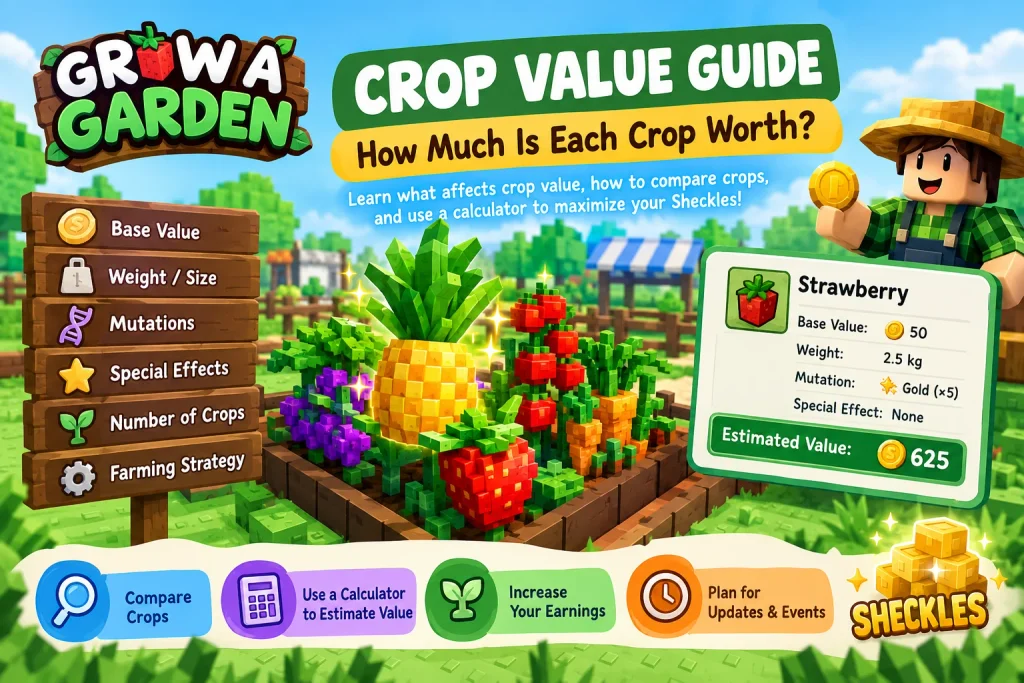
If you want to make more Sheckles in Grow a Garden, understanding crop value is just as important as choosing the right seeds. A crop may look ordinary when it is planted, but its final selling price can change depending on its type, size, weight, mutations, and other effects.
That is why experienced players do not simply ask, “Which crop is the best?” They also look at how much a crop can actually be worth when it is harvested.
In this Grow a Garden crop value guide, we’ll explain what determines crop value, why some harvests are worth much more than others, and how you can use a Grow a Garden calculator to estimate potential earnings before deciding what to grow.
What Determines Crop Value in Grow a Garden?
The value of a harvested crop is not always a simple fixed number. Several factors can influence how much you can earn from it.
The most important factors to pay attention to are:
- The base value of the crop
- Crop weight or size
- Mutations
- Special effects and bonuses
- The number of crops produced
- Your overall farming strategy
This means two crops of the same type may not necessarily give you the same amount of Sheckles.
For example, a normal harvest may have a relatively modest selling price, while a larger crop with valuable mutations can be worth significantly more. Understanding these differences is the key to making better planting decisions.
What Is Base Crop Value?
Base crop value is the starting value of a crop before additional bonuses or special effects are considered. Every crop has its own characteristics. Some crops are useful because they are easy to obtain and grow, while others can provide much greater value when you have the right conditions. However, base value should not be the only thing you consider.
A crop with a high starting value is not automatically the most profitable option for every player. You should also consider how efficiently you can grow it and whether you can increase its value through weight, mutations, or other bonuses. This is where calculating potential value becomes useful.
Why Crop Weight Matters
One of the most important things to understand about crop value is that the final value can be affected by the size or weight of the harvested crop. A heavier harvest can potentially be worth considerably more than a smaller version of the same crop.
This creates an important strategy for players who want to maximize profits. Instead of looking only at the name of a crop, pay attention to the final weight of the harvest. If you are consistently producing larger crops, your garden may generate much more value over time.
This is also why comparing crops using only their basic shop or seed prices can be misleading. A crop that appears less impressive at first may become much more valuable after producing a large harvest.
How Mutations Increase Crop Value
Mutations are another major part of the Grow a Garden economy. A mutation can change the value of a crop and make a harvest much more profitable than its normal version. Depending on the mutation and the current game mechanics, the effect can be substantial.
This is one reason players should pay attention to weather, events, pets, and other mechanics that can influence crop mutations. If you are specifically trying to maximize Sheckles, a mutated crop can completely change the value of a harvest.
However, mutation-focused farming can also involve more uncertainty. You should not assume that every harvest will receive the same bonus. Instead, think of mutations as a potential multiplier that can make an already valuable crop even more profitable.
Is the Most Expensive Crop Always the Best?
Not necessarily. One of the biggest mistakes new players make is assuming that the crop with the highest listed value is automatically the best crop to grow. Profit depends on more than the final selling price.
You should consider:
Seed cost: How much does it cost to start growing the crop?
Growth time: How long do you need to wait before harvesting?
Yield: How many useful harvests can you get?
Weight: How large can the crop become?
Mutation potential: Can its value increase through mutations?
Availability: Can you consistently obtain the seed?
A crop that sells for a high amount but takes significantly longer to produce may not always be the most efficient choice. For this reason, experienced players often compare profit per harvest and profit over time, rather than looking at one price.
How to Compare Two Crops
Suppose you are deciding between Crop A and Crop B. Crop A has a higher base value, but Crop B grows more quickly and can produce multiple harvests. Instead of immediately choosing Crop A, compare the total potential return.
You can ask:
- How much does each seed cost?
- How long does each crop take to produce?
- How much can one harvest be worth?
- How many harvests can I get?
- Can either crop benefit from useful mutations?
- Which option fits my available garden space?
This approach gives you a much better picture of actual profitability.
Use a Grow a Garden Calculator to Estimate Value
Manually comparing crop values can become difficult, especially when you start considering weight and mutations. That is where a Crop Value Calculator can make the process easier.
Instead of doing every calculation yourself, you can enter the relevant crop information and use the calculator to estimate potential value. A calculator is particularly useful when you are comparing several crops and want to quickly determine which one has the better potential return.
For example, you might compare:
- A high-value crop with a large weight
- A lower-value crop with a valuable mutation
- A crop with multiple bonuses
- Different possible harvest weights
- Different mutation combinations
Rather than guessing, you can use the available information to make a more informed decision.
How to Increase Your Crop Earnings
If your goal is to earn more Sheckles, focus on improving the overall value of your garden instead of relying on one specific crop.
1. Choose crops based on your goal
If you are a newer player, prioritize crops that are practical and accessible.
As your garden develops, you can start experimenting with higher-value crops and more advanced strategies.
2. Pay attention to crop weight
Do not ignore the size of your harvest. Larger crops can make a major difference when calculating total earnings.
3. Take advantage of mutations
Mutations can dramatically improve the potential value of a crop. Watch for opportunities that can increase mutation chances or improve your farming setup.
4. Use pets strategically
Pets can provide useful abilities that support different parts of your garden strategy. The best pet setup depends on what you are trying to accomplish.
For example, one setup may focus on crop production, while another may be more useful for players who are chasing valuable mutations.
5. Compare profit instead of price
A crop’s selling price is only one part of the equation. Consider the complete farming cycle before deciding what deserves your garden space.
Why Crop Value Changes Over Time
Grow a Garden is an evolving game, and its mechanics can change through updates, events, balancing adjustments, and new content. New crops may be introduced, existing mechanics may be adjusted, and special events can temporarily change the way players approach farming. Because of this, an old crop ranking may not always remain accurate.
Instead of relying on a single “best crop” list forever, learn how to evaluate crops based on their current value and your own farming setup. That approach will remain useful even when the game changes.
Final Thoughts
Knowing how much a crop is worth is one of the most useful skills you can develop in Grow a Garden. The final value of a harvest can depend on several factors, including its base value, weight, mutations, bonuses, and how efficiently you can produce it. This means the best farming strategy is not always about planting the crop with the biggest advertised price.
Instead, compare the complete picture. Look at the cost of the seed, the time required, expected harvest value, crop weight, mutation opportunities, and your available garden space. Once you start thinking about these factors together, it becomes much easier to identify profitable farming opportunities.
And when the calculations start getting complicated, a Pet Value Calculator can save time and help you compare different possibilities more easily.
Whether you are a beginner trying to build your first profitable garden or an experienced player looking for better ways to maximize Sheckles, understanding crop value is an important step toward becoming a more efficient gardener.
What determines crop value in Grow a Garden?
Crop value can depend on factors such as the crop’s base value, weight, mutations, and other applicable bonuses. This is why two crops of the same type can sometimes have different final values.
Does crop weight affect its value in Grow a Garden?
Yes. Crop weight is an important factor when estimating the final value of a harvest. Larger or heavier crops can be worth more than smaller versions of the same crop.
Do mutations increase crop value in Grow a Garden?
Yes. Mutations can increase the value of a crop, sometimes substantially. The exact effect depends on the mutation and the current game mechanics.
What is the most valuable crop in Grow a Garden?
There isn’t always one permanently best crop. Crop values, mutations, updates, and farming conditions can change, so it’s better to compare crops based on their potential value, growth time, weight, and other bonuses.
Is the most expensive seed always the most profitable?
No. A more expensive seed does not automatically provide the best return. You should also consider growth time, harvest quantity, crop weight, mutations, and the cost of obtaining the seed.
How can I calculate the value of a Grow a Garden crop?
You can use a Pet Value Calculator to estimate crop value using the relevant crop information, including factors such as weight and mutations. This makes it easier to compare different crops.
How can I make more Sheckles from crops?
Focus on crops that provide good returns for your available resources and garden space. Increasing crop weight, taking advantage of valuable mutations, using useful pet abilities, and comparing potential profits can all help improve your earnings.
Do pets affect crop value in Grow a Garden?
Some pet abilities can support your farming strategy and may help with crop production or other useful effects. The best pet setup depends on what you are trying to achieve in your garden.
Can weather affect crop value in Grow a Garden?
Certain weather effects can interact with farming and mutation mechanics. Because these mechanics can change with game updates, check the current in-game effects when planning your garden.
Why should I use a Grow a Garden Calculator?
A calculator makes it easier to compare potential crop values without doing every calculation manually. It can be especially useful when comparing different weights, mutations, and crop options.