
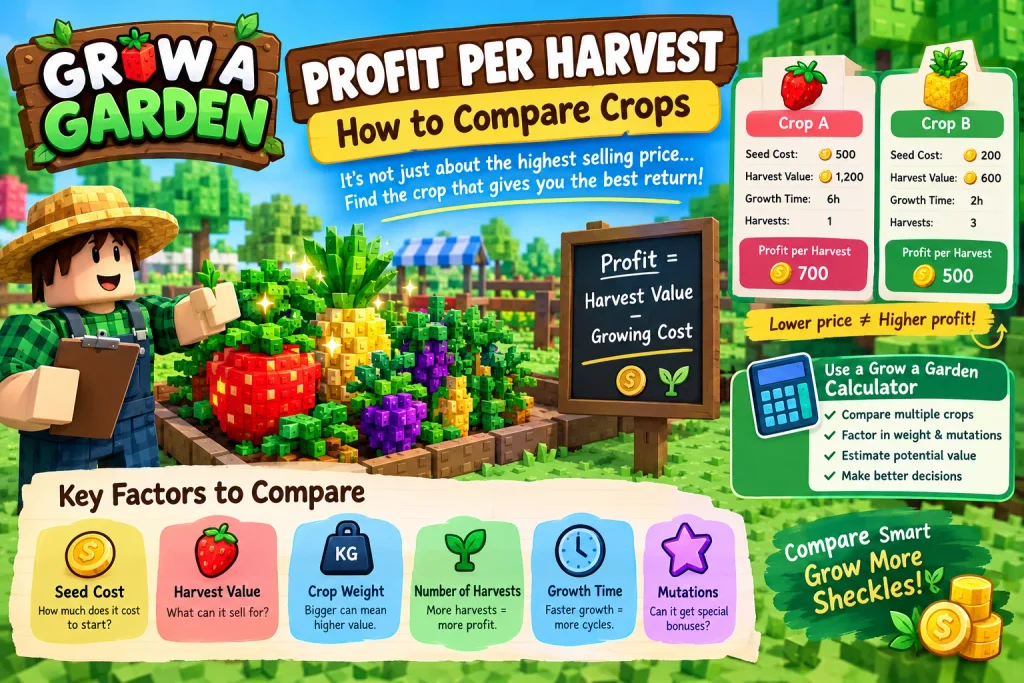
Making Sheckles in Grow a Garden is not simply about planting the crop with the highest selling price. If you want to build a profitable garden, you need to look at the bigger picture: seed cost, crop value, harvest quantity, crop weight, growth time, and potential bonuses. This is where Grow a Garden profit per harvest becomes useful.
Instead of asking which crop sells for the most, you can compare how much value you actually gain from each harvest. A crop with a lower individual selling price can sometimes be a better choice if it costs less to grow, produces more often, or takes less time to harvest.
CalculatorIn this guide, we’ll explain how to compare crops, what affects profit, and how a Grow a Garden Profit Calculator can make the process easier.
What Does Profit Per Harvest Mean?
Profit per harvest is the amount you effectively gain after considering the cost of producing a crop. A simple way to think about it is:
Profit = Harvest Value − Growing Cost
For a basic comparison, you can look at the value of the crop you harvest and subtract the cost associated with obtaining and growing it.
However, Grow a Garden can involve more variables than a simple buy-and-sell calculation. Crop weight, mutations, multiple harvests, and other effects can change the final result. That’s why comparing crops based only on their listed prices can lead to poor decisions.
Why the Highest-Value Crop Isn’t Always the Best
- Imagine two crops.
- Crop A produces a very expensive harvest, but its seed is costly and it takes longer to produce.
- Crop B has a lower selling value, but the seed is cheaper and you can harvest it more frequently.
- If you only compare the selling prices, Crop A looks better.
- If you compare the overall farming return, Crop B might be more efficient.
- This is an important distinction between crop value and crop profitability.
- Crop value tells you what a particular harvest may be worth. Profitability considers what you have to spend and how efficiently you can produce that harvest.
The Main Factors to Compare
When deciding which crop to grow, consider these factors together.
1. Seed Cost
Start with the cost of the seed. A crop that requires a large investment can still be profitable, but you need to determine whether its potential return justifies that investment.
When comparing two crops with similar harvest values, the cheaper seed may provide a better starting point.
2. Harvest Value
Next, consider how much the finished crop can be worth. Your Grow a Garden Crop Value Guide explains how factors such as crop weight and mutations can influence the final value. Do not assume that every harvest of the same crop will have exactly the same value.
3. Crop Weight
Weight can have an important effect on the value of a harvest. A heavier crop may provide a much better return than a smaller version of the same crop. This means that players should consider expected crop size when comparing potential profits. Rather than asking only, “How much is this crop worth?” ask:
“How much could this crop be worth at the weight I can realistically produce?”
4. Number of Harvests
Some farming strategies become more attractive when you consider how many times you can harvest them. A crop that can provide repeated returns may be useful for players who want consistent Sheckle generation. For this reason, a single-harvest comparison does not always tell the complete story.
5. Growth Time
Time is another important part of profitability. A crop with a large payout may seem impressive, but if another option produces valuable harvests much faster, the second crop may be more efficient over the same playing period.
This is especially important when you are actively managing your garden rather than simply waiting for crops to grow.
How to Compare Crops Step by Step
You can use a simple process whenever you’re deciding what to plant.
Step 1: Check the seed cost.
Determine how much you need to invest before the crop can produce value.
Step 2: Estimate the harvest value.
Consider the crop’s normal value along with factors such as weight and applicable bonuses.
Step 3: Account for mutations.
If mutations are possible, consider how they could change the potential value rather than treating every harvest as identical.
Step 4: Consider the growth period.
Think about how quickly you can turn your investment into another harvest.
Step 5: Compare the final return.
Look at the potential profit rather than focusing only on the crop’s selling price.
This method gives you a more realistic way to compare different farming options.
Profit Per Harvest vs Profit Per Hour
These two measurements are not the same.
Profit per harvest tells you how much you gain from one harvest after considering the relevant costs.
Profit per hour considers how quickly you can repeat the process.
For example, suppose one crop gives a larger profit from each harvest while another crop produces smaller profits much more frequently.
The first crop could have the higher profit per harvest, while the second could potentially generate more value over a longer period. Therefore, choose the measurement that matches your goal. If you’re comparing individual crops, profit per harvest is useful. If you’re planning an active farming routine, profit over time may be more important.
How Mutations Can Change Your Profit Calculation
Mutations add another layer to crop profitability. A normal crop and a mutated version of that crop can have very different values. This means you should avoid treating mutation bonuses as an afterthought when you’re comparing high-value farming strategies.
Your existing Understanding Grow a Garden Mutations: A Beginner’s Overview article can be used here as a deeper resource for readers who want to learn more about mutations. The important point is that mutation opportunities can affect your expected return.
However, you should avoid assuming that every crop will receive the most valuable possible mutation. A realistic comparison should account for what you can reasonably expect from your farming setup.
Use a Grow a Garden Calculator for Faster Comparisons
Doing these calculations manually can become confusing when you start comparing several crops and different scenarios. A Grow a Garden Plant Calculator can make the process much easier.
Instead of repeatedly calculating values yourself, you can use the calculator to compare potential outcomes and make your farming decisions more efficiently.
For example, you may want to compare:
- Different crop values
- Different crop weights
- Seed costs
- Potential mutations
- Harvest returns
- Multiple farming scenarios
The advantage is not simply saving time. A calculator also helps you make decisions based on numbers instead of guessing which crop looks better.
Tips for Improving Your Farming Profit
If you want to improve your Sheckle income, keep these principles in mind.
Don’t chase price alone
A high selling price does not automatically mean high profit.
Consider your available space
Your garden has limited space, so think about how much value each planting opportunity can provide.
Track your results
Pay attention to the actual harvest values you receive. Your own results can help you understand which strategies work best for your setup.
Use bonuses intelligently
When weather, mutations, pets, or other mechanics provide useful opportunities, consider how they affect your overall farming strategy.
Recalculate after updates
Game mechanics can change. A crop or strategy that performs well today may not remain the most efficient option after future updates.
Common Mistakes When Comparing Crop Profit
- One common mistake is comparing only the selling price.
- Another is ignoring the initial seed cost.
- Players can also overlook crop weight, growth time, and the possibility of multiple harvests.
- Finally, it is easy to assume that a rare or expensive crop must be the best investment. Rarity and profitability are not necessarily the same thing.
- A better approach is to compare the complete farming cycle.
Final Thoughts
Understanding Grow a Garden profit per harvest can help you make smarter decisions about what to plant. Instead of choosing crops based only on their advertised value, consider seed cost, harvest value, crop weight, growth time, harvest frequency, and possible bonuses. These factors give you a much clearer picture of how profitable a crop can actually be.
If you’re comparing several options, a Grow a Garden Plant Calculator can save time and make the process much easier. You can use it alongside your knowledge of crop values and mutations to build a farming strategy that fits your goals. The most profitable garden is not necessarily the one filled with the most expensive crops. It is the one where you understand the numbers and make each planting decision count.
What is profit per harvest in Grow a Garden?
Profit per harvest is the value you gain from a crop after accounting for the relevant cost of producing it. It helps you compare the actual return from different crops.
How do I calculate crop profit in Grow a Garden?
A simple calculation is harvest value minus growing cost. For more detailed comparisons, also consider crop weight, mutations, growth time, and the number of harvests you can produce.
Is a high-value crop always more profitable?
No. A high-value crop may require a larger investment or longer growth period. A cheaper or faster-growing crop can sometimes provide a better overall return.
Does crop weight affect profit?
Yes. If crop weight influences the final selling value, larger harvests can provide greater returns than smaller crops of the same type.
Should I compare profit per harvest or profit per hour?
It depends on your goal. Profit per harvest is useful for comparing individual crops, while profit over time is better for evaluating an active farming strategy.
Can mutations increase crop profit?
Mutations can increase the value of a crop and therefore improve potential profit. However, mutation outcomes should not be treated as guaranteed when estimating returns.
How can a Grow a Garden Calculator help?
A calculator can make it easier to compare crop values and different farming scenarios without performing every calculation manually. It is especially useful when several variables affect the final result.
What should I consider before planting a crop?
Look at the seed cost, expected harvest value, crop weight, growth time, harvest frequency, available garden space, and potential bonuses. Comparing these factors gives you a better idea of the crop’s profitability.