
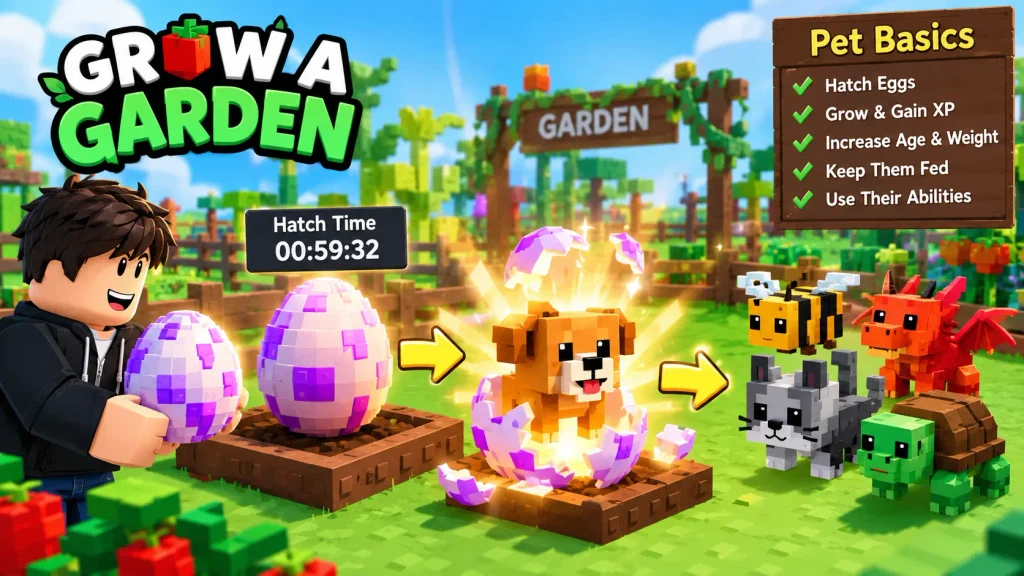
Pets have become one of the most interesting parts of Grow a Garden on Roblox. At first, the system looks simple: get an egg, wait for it to hatch, and equip the pet you receive. But once you start collecting different pets, you’ll notice that there is much more going on.
Pets can gain experience, grow older, become heavier, and provide abilities that can make a real difference to your garden. Knowing how these mechanics work can help you avoid wasting eggs and make better decisions about which pets are worth keeping.
If you’re new to Grow a Garden or simply want a clearer explanation of the pet system, here’s what you need to know.
How Do Pets Work in Grow a Garden?
Pets are companions that provide special abilities while you play. Depending on the pet, its ability can help with different parts of your garden and progression.
The first step is getting a pet, and that usually means getting an egg. Different eggs have different pet pools, which means the pets you can hatch depend on the egg you’re using. Some eggs are easier to obtain, while others may be associated with particular events or limited-time content.
Because of this, it’s a good idea to check what an egg can hatch before spending your resources on it. A pet isn’t automatically useful just because it is difficult to obtain. Its ability is often more important when deciding whether it belongs in your main setup.
How to Hatch a Pet Egg
Hatching an egg is fairly straightforward. After obtaining a Pet Egg, equip it from your inventory and place it on your garden plot. The egg will display a hatch timer, and you’ll need to wait until that timer finishes.
When the timer reaches zero, the egg hatches and gives you a pet from its available pool. You don’t normally get to select the pet yourself. Instead, the result is determined by the chances associated with that egg.
This means getting a particular pet can sometimes take several attempts. If you’re hunting for a specific pet, don’t be surprised if the first few eggs don’t give you the result you were hoping for.
A simple example
Imagine an egg has several possible pets. One might have a high chance of appearing, while another might be much harder to hatch. You could open the same type of egg multiple times and receive the more common pets before eventually getting the rarer one.
That’s an important part of the egg system, so it’s better to think of each egg as a chance rather than a guarantee.
What Happens After the Egg Hatches?
Once your egg opens, the pet becomes available for you to use. Every pet has its own ability, and that ability is what gives the pet its value. Some pets may be useful for farming, while others can provide different bonuses or effects that fit specific playstyles.
This is why comparing pets purely by rarity isn’t always a good idea. A pet with a common rarity can still be useful if its ability works particularly well with your garden. Likewise, a rare pet isn’t necessarily the best choice for every situation. When you hatch something new, take a moment to read its ability before deciding what to do with it.
How Does Pet Growth Work?
Hatching a pet is only the beginning. Pets can gain XP as you use them, allowing them to increase in age. As they grow older, their weight can also increase.
The XP requirement changes as pets progress through their ages. Early growth can feel fairly quick, but reaching higher ages requires more experience and patience.
This gives the pet system a progression element. Instead of constantly replacing your pets, you can choose a useful pet and gradually invest time into growing it. For players who find a pet that works particularly well with their garden, aging that pet can be worthwhile.
Why Is Pet Age Important?
Pet age can affect the performance of its ability. Depending on the pet, growing older can improve certain aspects of its ability. This can include things such as a stronger effect, better statistics, or a shorter cooldown.
However, there isn’t one rule that applies perfectly to every pet. Each pet has its own ability and mechanics, so the benefits of aging can vary. Before spending a lot of time trying to grow a particular pet, it’s worth understanding what its ability actually does.
If you use a pet frequently and its ability becomes more effective with age, keeping it around can be a better choice than constantly replacing it.
Don’t Ignore Pet Hunger
Hunger is another part of the pet system that new players sometimes overlook. Pets have a hunger value, and keeping that value maintained is important if you want them to continue progressing normally. If a pet’s hunger reaches zero, its aging can stop until the hunger issue is dealt with.
So, if you notice that a pet doesn’t seem to be getting older, don’t immediately assume that something is broken. Check its hunger first.
This is particularly important when you’re trying to grow a pet to a higher age. Keeping your pet properly maintained means you won’t accidentally slow down its progress.
What Does Pet Weight Mean?
Pet weight is another statistic you’ll see when managing your pets. A pet has a starting weight when it hatches, and that weight can increase as the pet ages. For some pets, weight has an effect on how their abilities perform.
This makes weight something worth paying attention to, particularly if you’re interested in optimizing your pet collection.
Two pets of the same type can have different starting weights, so players who are building an optimized setup may compare their pets instead of automatically keeping the first one they hatch.
Pet weight can affect how efficiently some pet abilities perform. If you want to quickly compare values and work out the numbers for your garden, you can use our Pet Weight Calculator.
Is a Heavier Pet Always Better?
Not necessarily. It’s tempting to assume that a heavier pet must always be the better option, but what matters is how that weight interacts with the pet’s ability.
Some abilities benefit more noticeably from increased weight, while other mechanics may work differently.
For that reason, don’t judge a pet only by its weight. Look at the complete picture, including its ability, age, and how useful it is for your particular garden. A slightly lighter pet with a much more useful ability may still be the better pet to keep.
How Long Does It Take for a Pet to Grow?
There isn’t one fixed amount of time that applies to every stage of every pet. Pets progress through XP, and the amount of XP needed increases as they reach higher ages. Because of this, early growth tends to feel faster than later progression. Your own setup and how you play can also affect how quickly a pet progresses. If you’re working toward a particular age, the best approach is to keep using the pet, pay attention to its hunger, and give it time to gain XP naturally. Trying to rush the process isn’t always necessary.
Growth and pet values can be easier to understand when you can calculate them instead of guessing. Our Pet to Grow Calculator can help you work out the numbers quickly.
Which Pets Should You Keep?
As you collect more eggs, you’ll eventually have to decide which pets are worth keeping.
Instead of looking only at rarity, consider the following:
- Ability: Does the pet actually help your garden?
- Age: Have you already invested a lot of time into growing it?
- Weight: Does its ability benefit from additional weight?
- Usefulness: Does it fit your current farming strategy?
- Duplicates: Do you already have another pet that does the same job?
These questions can help you make better decisions than simply keeping every rare pet you hatch.
Beginner Tips for the Pet System
If you’re just starting out, you don’t need to worry about optimizing everything immediately. Start by learning what your pets actually do. Try different abilities and see which ones fit your style of playing.
It’s also worth checking an egg’s possible rewards before spending resources on it. If you’re looking for a particular pet, understanding the egg’s pet pool can help you set realistic expectations.
Most importantly, don’t be afraid to keep a pet that you enjoy using. The strongest setup on paper isn’t always the most enjoyable one to play.
Final Thoughts
The pet system in Grow a Garden is easier to understand once you break it into a few basic steps. First, you get an egg and wait for it to hatch. Then you decide whether the resulting pet is useful for your garden. If you keep it, the pet can gain XP, grow older, and increase in weight over time.
The biggest thing to remember is that rarity isn’t everything. A pet’s ability, age, weight, and usefulness to your particular setup all matter when deciding which pets deserve a place in your garden.
And because Grow a Garden continues to receive updates, the pet system can change over time. New eggs, pets, abilities, and events may be introduced, so it’s always worth checking the current game information when making decisions about your collection.
For new players, though, the best approach is simple: hatch some eggs, learn what your pets do, keep the ones that actually help you, and let your favorites grow as you play.
How do I hatch a pet in Grow a Garden?
Obtain a Pet Egg, equip it, and place it on your garden plot. Once the hatch timer finishes, the egg will produce a pet from its available pool.
Why has my pet stopped aging?
Check the pet’s hunger. If its hunger has reached zero, it may stop aging until it is fed again.
Does pet age make pets better?
For many pets, aging can improve parts of their abilities. The exact benefit depends on the individual pet.
Does pet weight matter?
Weight can matter for certain pets because some abilities are affected by the pet’s weight. The effect isn’t identical for every pet.
Should I keep every rare pet?
Not necessarily. A pet’s ability and usefulness for your garden can be more important than rarity alone.
Can pets become heavier as they grow?
Yes. Pet weight can increase as a pet gains age and XP.